
Low-Latency Private 5G for Critical Operations

By Challenge

Some Messages Can't Wait for Shared Bandwidth.

When a safety system sends an alert, a control loop closes a valve, or a machine-to-machine command triggers a production step, the network needs to deliver that message not route it through a best-effort queue behind someone's video call. Shared infrastructure can't make that guarantee. Network slicing can.

NEW TO PRIVATE 5G?

Private 5G is a private cellular network you own and operate on your own site. It runs on CBRS: shared 3.5 GHz spectrum the FCC opened for enterprise use, with no carrier subscription and no spectrum license to buy. The result is carrier-grade coverage, security, and reliability under your control.

How It Works
The Problem

Best-Effort Is Not a Safety Architecture

On a flat, shared network, every packet competes equally for bandwidth. A large file transfer, a software update, or a video stream can crowd out the 50-byte sensor reading that tells a safety system whether a valve is open or closed. Most of the time this works fine. The failures are rare until they aren't, and the consequences are serious.

The Answer

Guaranteed Lanes, Not Priority Queues

LG Private 5G's network slicing creates logically isolated networks on a single physical infrastructure. Your OT control traffic runs on its own slice with a dedicated bandwidth allocation and latency SLA. IT traffic runs on a separate slice. Guest devices run on another. Each slice behaves like its own private network the contention between them is architectural, not policy-based.


Wi-Fi vs. Private 5G

How They Handle Critical Traffic

WI-FI

  • QoS tags can prefer critical traffic, but it still shares one congested medium.
  • Best-effort delivery: a file transfer or video stream can crowd out a safety signal.
  • Rare congestion events delay the messages that matter most.

LG PRIVATE 5G

  • Network slicing gives OT traffic its own guaranteed lane, isolated by architecture.
  • Guaranteed bandwidth and low, predictable latency on the critical slice.
  • Critical slices keep their resources regardless of other network activity.

Use Cases

Communications That Cannot Be Interrupted

These use cases depend on guaranteed latency and bandwidth not best-effort delivery.

Manufacturing

Run Heavy Equipment With a Human in the Loop

Learn more
Manufacturing

Run Heavy Equipment With a Human in the Loop

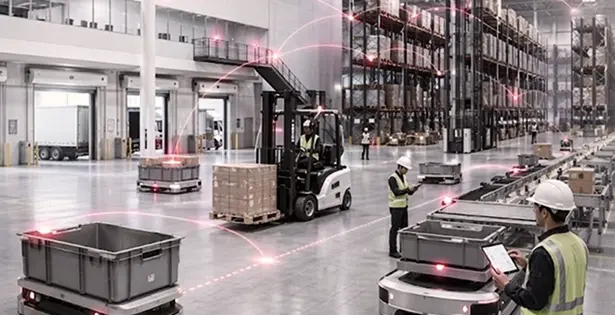
Autonomous forklifts and reach trucks increasingly run with a remote operator who steps in for edge cases, tight docks, and hazardous moves. That handover only works if the control and video links never lag, because a moving lift truck can't wait on a dropped frame. Deterministic low latency is what makes teleoperation safe at scale, and it's the one thing enterprise Wi-Fi can't guarantee.

Ports & Maritime

Keep Cranes Moving and Vessels on Schedule

Learn more
Ports & Maritime

Keep Cranes Moving and Vessels on Schedule

Remote crane control and automated stacking depend on a control link that holds under load, all day, in the open. A slice with guaranteed resources keeps those commands moving while camera feeds, telematics, and office traffic share the same physical network.

Healthcare

Keep Patients Continuously Monitored

Learn more
Healthcare

Keep Patients Continuously Monitored

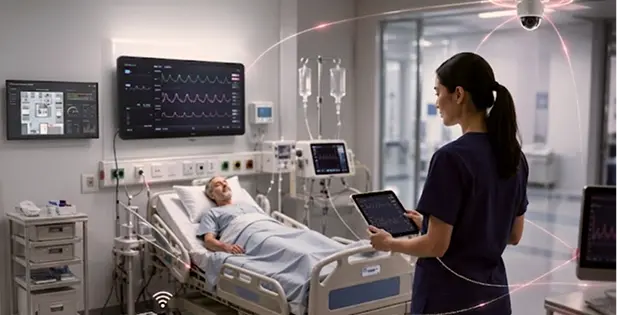
Telemetry from bedside monitors and infusion pumps is not traffic that can be retried later. A dedicated clinical slice carries those readings with a latency guarantee, separate from guest Wi-Fi and administrative systems on the same building network.

Warehousing & Logistics

Ship on Time, Even at Peak

Learn more
Warehousing & Logistics

Ship on Time, Even at Peak

Sortation, conveyor control, and AMR traffic all have to keep their timing during the busiest hour of the busiest week. Slicing keeps the control plane clear of scanner uploads and video, so the same network that runs the building does not slow the line down.

Oil & Gas

Keep Workers Safe in the Areas Coverage Forgets

Learn more
Oil & Gas

Keep Workers Safe in the Areas Coverage Forgets

Gas detection, man-down alerts, and emergency shutdown commands are exactly the messages that cannot queue behind a routine data upload. A guaranteed lane carries them across the plant, including the outdoor and remote areas that shared infrastructure covers poorly.

Venues & Stadiums

Keep Security Seeing and Talking When the Crowd Peaks

Learn more
Venues & Stadiums

Keep Security Seeing and Talking When the Crowd Peaks

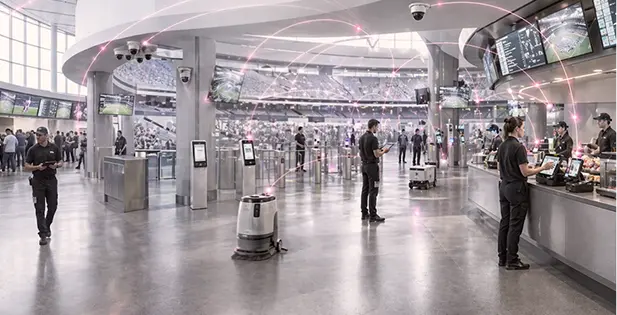
Security radios, body cameras, and incident video need to work in the exact moment the public bands are saturated with tens of thousands of phones. Their traffic runs on its own slice, so the crowd that creates the risk does not also take down the response.


Why LG Private 5G

Network Slicing by Architecture

3GPP Network Slicing

LG Private 5G implements 3GPP Release 16+ network slicing the same standards that 5G carriers use for service differentiation. Each slice has its own QoS policy, bandwidth allocation, and security boundary, enforced at the radio access layer, not just in software policy.

Low, Predictable Latency

LG Private 5G delivers consistently low latency for OT slice traffic, and just as important, it stays predictable under load rather than spiking the way shared Wi-Fi does as the network fills up. For control loops, safety systems, and real-time automation, that consistency is the difference between a functional architecture and one that isn't.

On-Premises Processing

LG's vCore can run on-premises, keeping OT traffic entirely within the facility perimeter. Control commands, safety signals, and machine telemetry never touch the public internet reducing attack surface and eliminating cloud-introduced latency from the critical path.

Built for What's Next

More Automation Means More Critical Traffic

As automation expands, the volume and criticality of machine communications grows with it. The network supporting your operation in 2028 will carry more safety-critical traffic than it does today. LG Private 5G's slicing architecture scales with that growth adding new slices for new use cases without disrupting existing ones, and without requiring a network redesign when requirements change.

See the Technology