
Private 5G for Venues & Stadiums

By Industry

The Day You Sell Out Shouldn't Be the Day Your Systems Can't Keep Up.

A venue gets only so many sold-out days a year, and most of the revenue rides on a few packed hours. When the building fills, the systems that capture that revenue and keep the crowd safe, point-of-sale, ticketing, cameras, staff radios, all fight for the same airwaves the fans are saturating. Private 5G is the right tool for those operational systems: a dedicated layer that keeps working when the public airwaves are jammed. When those systems hold under peak load, the lines move, the crowd stays safe, and the revenue window stays open.

The Challenge

On Event Day, Every Revenue and Safety System Runs at Once

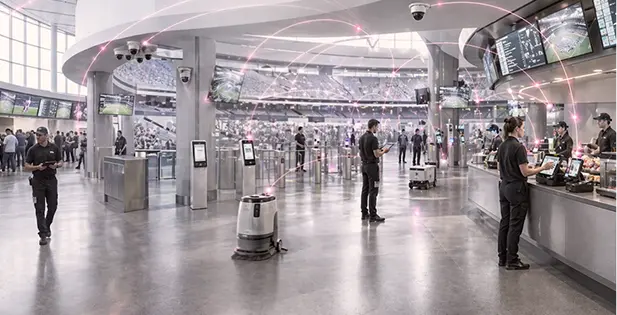
A full venue is dozens of operations running at maximum pressure at the same moment: concessions and retail ringing transactions, gates scanning tickets, security watching the crowd, staff coordinating across the bowl and back-of-house, vendors and sponsors activating, displays pushing menus and wayfinding. Every one of them depends on connected devices, and they all peak together, exactly when tens of thousands of phones are saturating every public frequency in the building.

Private 5G isn't here to replace fan Wi-Fi or the DAS that carries carrier traffic. It's the dedicated layer for the operational and revenue systems that have to work when the building is full, separate from the fan-facing network and protected from the congestion that hits it at kickoff. Wired drops are slow and costly to add across a structure this size, and the event layout changes with every booking. Private 5G connects the systems that move, change, or sit where pulling cable is impractical, working alongside the networks already in place. The use cases below show where it protects the operation first.

  • Revenue and safety systems that hold when the building is at capacity

    Massive device densitythousands of operational endpoints stay connected under peak crowd load

  • Operations, security, and premium traffic kept in separate lanes

    Network slicingisolated segments on one physical network, separate from fan connectivity

  • Endpoints live where cable can't reach, in days not weeks

    Cable-free deploymentconnect temporary vendors, gates, cameras, and outdoor zones without trenching

  • Only trusted devices on the venue operations network

    SIM-based authenticationno rogue endpoints, PCI-friendly segmentation for payments

  • Coverage that holds outdoors across lots, plazas, and the bowl

    Outdoor-rated hardwarereliable where public coverage and Wi-Fi drop out

Why LG

We're Already in Venues Like Yours

LG doesn't arrive at the venue as a stranger. LG commercial displays already run in major sports and entertainment venues, scoreboards and ribbon boards, concourse and menu boards, club and suite screens, including the Stadium Series DVLED built for the outdoor sporting environment and large display refreshes at venues like AT&T Stadium and Fenway Park. We know what it takes to put a connected endpoint into a packed, live building and keep it running through an event.

Use Cases

Where LG Private 5G Makes a Difference

Real-Time Decisions

When Event-Day Systems Act on Their Own, the Data Has to Be Right

More of what happens in a full venue is now decided automatically or in the moment: vision systems reading access and crowd density, cashierless checkout charging a cart on the way out, analytics tuning staffing and queue flow, security platforms triaging alerts. Each of those decisions is only as good as the data underneath it. When the network drops a camera feed or loses a payment session, the system doesn't pause and wait; it acts on stale or partial data, and the wrong call lands at the worst possible moment: a charge missed, an alert lost, a gate backed up with the building full. A deterministic network isn't just about staying connected. It's about whether the systems a venue increasingly runs on are working from data it can trust.

Key Outcomes

What Venue Operations Teams See After Deployment

  • Transactions that clear fast under peak crowd load, protecting per-cap revenue
  • Displays and signage deployed and moved without a cabling project each time
  • Faster gate ingress with fewer manual ticket exceptions
  • Security cameras and staff comms that hold when crowd density is highest
  • Temporary event zones, vendors, and outdoor operations online without new wiring
  • New managed-connectivity revenue from vendors and sponsors on the venue network