
Private 5G for Warehousing & Logistics

By Industry

A Dead Zone Shouldn't Be What Misses Your Ship Window

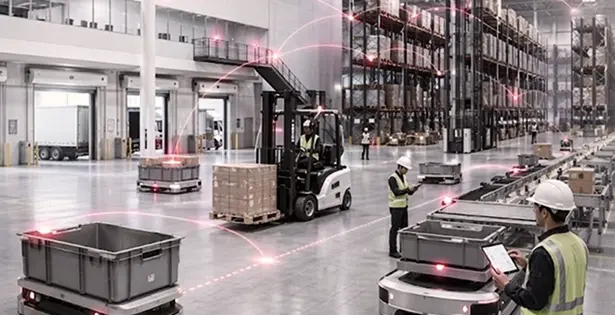
A warehouse makes money by moving product, and the whole operation now runs on wireless: forklifts, AMRs, scanners, dock cameras, and the WMS that orchestrates them. One dead zone and a robot waits for rescue, a dock backs up, a picker drops to manual. Miss a ship window and the damage outlasts the bad day: chargebacks, SLA penalties, and a customer who trusts your delivery promise a little less, and it lands hardest at peak. LG Private 5G gives the building a deterministic, dead-zone-free network, so the thing that slows the operation is never the network.

The Challenge

When Automation Becomes Mission-Critical, the Network Becomes Part of the Material Handling System

A distribution center is one of the hardest wireless environments to cover well. Steel racking that shifts with every reslot, moving equipment, hundreds of thousands of square feet of floor plus outdoor yard, and a peak season that packs the building with more inventory, more devices, and more temporary labor than the network was ever sized for. When connectivity slips, the robot is still autonomous but the workflow waits.

  • Automation that stays connected aisle to dock to yard

    Seamless mobilityHandover with no gaps across the full footprint

  • Remote-assist forklifts that need video and control in real time

    Deterministic low latencypredictable response, not best-effort

  • Thousands of scanners, tags, and robots online, even at peak

    Massive device densityon dedicated spectrum, no contention

  • Automation traffic protected when seasonal headcount spikes

    Network slicingisolated lanes on one infrastructure

  • Only trusted devices on the operations network

    SIM-based authenticationno rogue devices, no shared passwords

Why LG

We Move Product at Scale Too

LG doesn't come to logistics as an outsider selling network gear. We run high-volume manufacturing and distribution operations around the world, moving our own product through plants, warehouses, and docks every day. We've lived with the steel-racking dead zones, the reslot that breaks coverage, the outdoor yard Wi-Fi never reached, and the peak season that doubles everything at once. The same LG team that builds smart-factory and warehouse-automation systems helps shape LG Private 5G, so it's designed around how a building actually runs at peak, not how a coverage map says it should.

Use Cases

Where LG Private 5G Makes a Difference

Real-Time Decisions

When the Warehouse Decides for itself, the Data Has to Be Right

More of what happens in the building is now decided automatically: the WMS orchestrating tasks, AMRs rerouting around congestion, vision systems passing or failing a load, slotting logic moving inventory. Every one of those decisions is only as good as the data underneath it. When the network drops a video frame or loses a robot's position, the system doesn't pause and wait. It acts on stale or partial data, and the wrong call gets made at machine speed, a robot sent down a blocked aisle, a bad load cleared to ship. A deterministic network is no longer just about keeping things moving. It's about whether the automation you're trusting is working from data you can trust.

Deployment Reference

Private 5G in a Live Distribution Center

A major distribution center operator deployed LG Private 5G across a single high-volume facility, running mobile automation and handheld devices on one dedicated network.

FootprintDevicesOutcome
54,000 m² distribution center~180 connected (AMR, PDA, tablet)Smart warehouse with improved logistics efficiency and real-time WMS synchronization

Reference deployment. Geography and operator anonymized at customer request.

Key Outcomes

What Distribution Operations See After Deployment

  • Higher automation uptime, with robots and forklifts moving instead of waiting for manual rescue
  • Faster dock turns and fewer missed ship windows from connected yard and trailer coordination
  • Higher pick accuracy from real-time scan confirmation, reducing returns and rework
  • Less time and labor lost hunting for pallets, carts, and assets across the footprint
  • More predictable performance at peak, when device and labor density are highest