Private 5G for Airports

By Industry

A Dead Zone Shouldn't Be What Holds an Aircraft at the Gate

An airport runs dozens of wireless operations across terminal, apron, and airfield, and no single network is the right fit for all of them. Wi-Fi, DAS, and carrier each have their place. Private 5G is the right tool where coverage has to be dedicated and dependable: terminal displays and POS that can't drop a transaction, and apron and ramp work that has to stay connected outdoors, where Wi-Fi thins and new cable is slow and costly. Putting those systems on one private layer keeps the operation moving together, so turns run faster and new endpoints go live in days.

The Challenge

An Airport Is Dozens of Operations Sharing One Footprint, and Most of Them Have Moved to Wireless

Terminal, concourse, apron, bag room, curb, parking, perimeter, airfield: an airport runs many operations at once, each with its own systems, devices, and operators, spread across indoor and outdoor space that changes constantly as construction, seasonal concessions, and irregular operations reshape it. More of that work has moved to wireless endpoints that need to be connected wherever they happen to be, not wherever the cable already runs.

Wired infrastructure does not move easily, and at an airport almost nothing about adding it is simple: pathway surveys, off-hour labor, badging and escort, coordination across airport IT, facilities, airlines, tenants, and TSA, then testing and closeout. The cable is rarely the real cost; the airport environment is. Private 5G is another way to connect the systems that move, change, or sit where pulling cable is slow, expensive, or disruptive, working alongside the networks already in place rather than replacing them. The use cases below show where it protects the operation first.

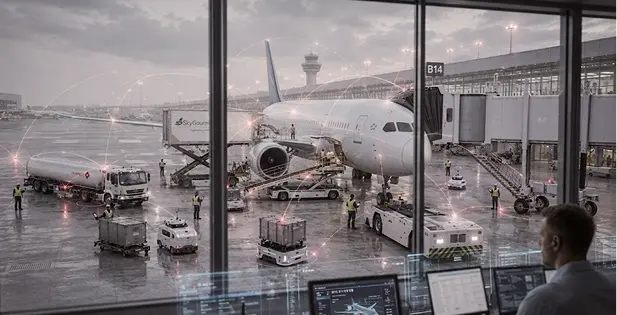
  • Crews and vehicles that stay connected from the gate to the far apron

    Full-footprint coverageno dead zones at the stand or the fence line

  • Endpoints that go live where cable can't easily reach, in days not weeks

    Cable-free deploymentconnect the apron, curb, and temporary stands without trenching

  • Operations, tenant POS, and passenger traffic kept in separate lanes

    Network slicingisolated, PCI-friendly segments on one network

  • Only trusted devices on the airport operations network

    SIM-based authenticationno rogue endpoints, no shared passwords

  • Radios that hold up on the ramp through weather and jet blast

    Outdoor-rated hardwarereliable where public coverage and Wi-Fi drop out

Why LG

We're Already in Airports Like Yours

LG doesn't arrive at the airport as a stranger. LG commercial displays already run across terminals as flight information, gate and wayfinding screens, baggage-claim and security boards, and concession menus, with New York's LaGuardia Terminal B alone running dozens of them. We know what it takes to put a connected endpoint into a live terminal and keep it running, and we build the outdoor-rated radios the apron and airfield demand, with full-footprint coverage from curb to stand to fence line.

Use Cases

Where LG Private 5G Makes a Difference

Real-Time Decisions

When the Airport Runs on Real-Time Data, the Data Has to Be Right

More of what happens across an airport is now decided automatically or in the moment: A-CDM platforms sequencing turns, vision systems reading bag tags and plates, queue analytics redirecting staff, ground systems coordinating GSE. Each of those decisions is only as good as the data underneath it. When the network drops a scan or loses a vehicle's position, the system doesn't pause and wait; it acts on stale or partial data, and the wrong call gets made at the worst time: a bag misrouted, a turn milestone missed, a gate held. A deterministic network isn't just about keeping things connected. It's about whether the systems an airport increasingly runs on are working from data it can trust.

Key Outcomes

What Airport Operators See After Deployment

  • More turns held to schedule from ramp, stand, and ground operations that stay connected through the whole turn
  • Faster, cheaper endpoint deployment from displays, cameras, and sensors that go up without trenching or off-hour cable runs
  • Concessions and tenants live sooner from POS and kiosks connected without a fixed data drop
  • Fewer mishandled bags and faster cargo reconciliation from continuous tracking across the bag room and below the terminal
  • Security and construction cameras live in days, anywhere on the field, with coverage that follows the operation instead of the fiber
  • Stronger perimeter and airfield security from full-coverage wireless cameras and sensors