Keep Workers Safe in the Areas Coverage Forgets

Worker safety is the first thing connectivity puts at risk in oil and gas, and the places people are most exposed, confined spaces, tank interiors, remote pads, deep inside process units, are exactly where carrier signal and Wi-Fi give out. Lone-worker monitoring, man-down and gas-exposure alerts, push-to-talk, biometric wearables, and live video to a remote expert run on full-footprint Private 5G coverage. When an alarm sounds, real-time location turns muster and headcount into seconds instead of a manual roll call. Faster response and accountability in the conditions where radios and public networks leave gaps.
Keep Upstream Production Flowing Across Remote Sites

Wellpads, pump jacks, wellhead and drilling equipment, tank levels, and pipeline assets sit where production starts and where a site visit costs the most. Continuous monitoring of pressure, flow, vibration, and tank telemetry over Private 5G surfaces an anomaly before it becomes lost production, and connects the controllers, sensors, and cameras at remote sites without waiting on carrier coverage that doesn't reach. Fewer truck rolls, faster response to a pressure or flow event, and real visibility into the upstream sites where downtime carries the highest cost.
Catch Equipment Faults Before They Cost a Day of Production

Pumps, compressors, motors, and rotating equipment fail in ways that vibration, thermal, acoustic, and pressure sensors can see coming, if the data gets back reliably across a noisy, hard-to-wire plant. Private 5G carries that sensor density in real time to condition-monitoring and SCADA systems, so faults get caught before they become outages. Ericsson estimates oil and gas network failures can cost up to a million dollars a day in lost production; catching the fault first is what keeps a day of production from going with it.
Inspect Hazardous Assets Without Putting People in Harm's Way

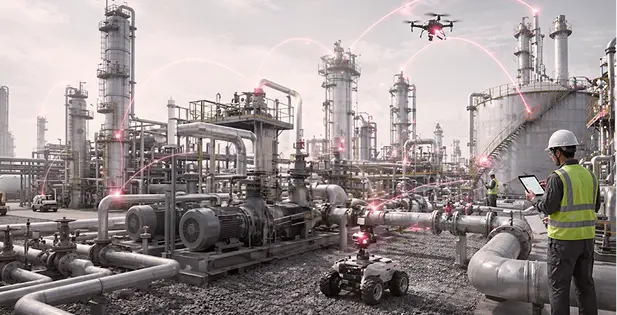
Flare stacks, tank interiors, pipelines, and confined spaces are dangerous, slow, and expensive to inspect by hand, often requiring scaffolding, rope access, or a permit to enter at all. Drones, crawlers, and fixed cameras stream high-resolution and thermal video over Private 5G across large outdoor footprints, so inspections happen more often, with fewer people exposed and fewer confined-space entries. Defects surface earlier, and the network carries the uplink that live inspection video demands.
Stand Up a Turnaround Without Waiting on Fixed Infrastructure

Turnarounds and shutdowns are time-compressed, contractor-heavy, and exactly when connectivity is hardest to guarantee. A turnaround is not the moment to discover the network can't support temporary workers, cameras, safety systems, and digital work packages. A Private 5G deployment brings up contractor trailers, temporary cameras and safety monitoring, work-order and permit-to-work workflows, and temporary muster points fast, then comes down when the project ends. Faster setup, less temporary cabling, and safety visibility across the project from day one.
Detect Leaks and Environmental Events Before They Escalate

A methane leak, a tank-vapor event, or a spill is a safety, compliance, and production problem at once, and the sooner it's detected, the smaller it stays. Fixed and mobile sensors for methane, air quality, flare performance, and leak detection stream continuously over Private 5G across tank farms, loading racks, and remote assets that are costly to wire and easy to leave on manual rounds. Earlier detection, faster corrective action, and a continuous record where environmental risk is a board-level concern.