Keep Cranes Moving and Vessels on Schedule

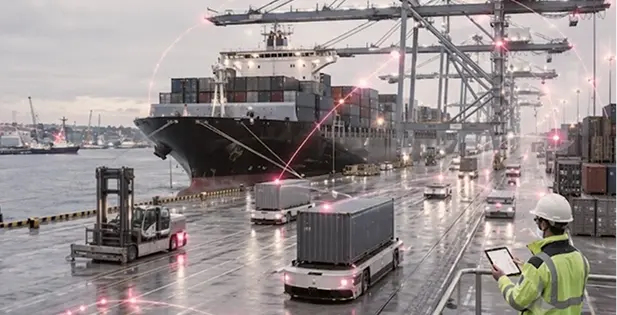
Ship-to-shore and RTG cranes set the pace of the whole terminal, and every move per hour shortens vessel berth time. Remote-controlled and automated cranes run on continuous HD video, 3D sensor feeds, and control data that can't tolerate a dropped frame. Deterministic low latency and full-quay coverage keep those links live, so crane productivity holds and ships clear the berth on schedule.
Keep Autonomous and Yard Vehicles in Motion

AGVs, autonomous terminal tractors, straddle carriers, reach stackers, and top handlers only create value when they keep moving. A connectivity gap turns into a stopped vehicle, a safety hold, or a manual intervention that backs up the yard. Reliable positioning, telemetry, and remote-assist video over Private 5G keep vehicles productive and let one operator supervise several, stepping in only for exceptions.
Clear Trucks Through the Gate Faster

Gate congestion costs the terminal, the driver, and the cargo owner at once. Wireless OCR portals, license-plate and container-ID capture, driver kiosks, and appointment systems process trucks faster and cut manual exceptions. Shorter turn times and shorter queues mean more transactions through the same gates, with a cleaner data trail into your TOS.
Know Where Every Container Sits
When the terminal doesn't know where a box is, people waste time searching and equipment makes moves it didn't need to. Dense RFID, sensor, and camera tracking over Private 5G gives continuous container location and yard inventory across the full stacked footprint. Fewer rehandles, faster exception resolution, and a TOS that reflects where things actually are.
Protect Reefer Cargo Before It Spoils

A missed reefer alarm turns a network issue into spoilage, claims, and a liability problem. Continuous temperature, power, and plug-status telemetry from refrigerated containers reaches operations in real time across the stacking yard, so excursions surface before cargo is lost. Fewer manual reefer checks, faster response, and better cold-chain compliance on high-value loads.
Catch Equipment Faults Before They Stop the Berth

Crane or equipment downtime ripples across the berth, the yard, and the truck gate. Vibration, motor, drive, and tire sensors plus video analytics stream continuously to condition-monitoring systems, so faults get caught before they become failures. Less unplanned downtime on the critical equipment that vessel and yard operations depend on.
Keep Workers Safe and Connected Across the Terminal

Ports are high-risk industrial environments where radio coverage and public networks leave gaps. Push-to-talk over cellular, man-down alerts, lone-worker protection, wearables, and vehicle-pedestrian proximity warnings run on full-footprint Private 5G coverage. Faster emergency response and better situational awareness across berth, yard, gate, and remote lots.
See the Whole Terminal Without Trenching Fiber

Ports cover large areas that are expensive to cable, and the spots that matter most for security are the hardest to reach. High-resolution perimeter and yard cameras, mobile patrol tablets, and drone video backhaul connect wirelessly across berths, fences, gates, and remote lots. Better security visibility and faster incident detection without running fiber everywhere.
Put Operational Signage Where the Terminal Needs It

Ports constantly reconfigure traffic flows, gates, staging areas, and safety zones. Connected digital signage turns gate boards, truck-queue displays, driver instruction boards, safety messaging, and control-room video walls into operational visibility points, not just screens. Private 5G makes those displays easier to place, move, and update as terminal conditions change, with LG's own commercial display portfolio behind them.