

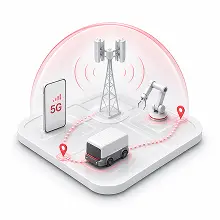
Private 5G for Security and Compliance

By Challenge

Shared Networks Create Shared Risk.

When OT and IT traffic share the same infrastructure, the boundary between production systems and everything else becomes a policy decision not an architectural one. Policies get misconfigured. Patches get skipped. And a ransomware event that starts on the IT side now has a pathway to production. Private 5G changes the architecture, not just the policy.

NEW TO PRIVATE 5G?

Private 5G is a private cellular network you own and operate on your own site. It runs on CBRS: shared 3.5 GHz spectrum the FCC opened for enterprise use, with no carrier subscription and no spectrum license to buy. The result is carrier-grade coverage, security, and reliability under your control.

How It Works
The Problem

The Perimeter Has Moved to the Factory Floor

OT security was not a priority when production systems ran on isolated, air-gapped networks. Digitization changed that. Today, the same network carrying ERP data and email traffic often reaches SCADA systems, PLCs, and industrial controllers. That convergence brings operational visibility and new attack surface.

The Answer

Security by Architecture, Not Policy

LG Private 5G creates hard network boundaries through 3GPP network slicing and SIM-based device authentication. OT devices are provisioned with SIMs that authenticate to the private network not to a shared credential. They connect to their dedicated slice and only that slice. A compromised IT device doesn't have a path to OT traffic, because they're not on the same logical network.


Wi-Fi vs. Private 5G

How They Handle OT/IT Separation

WI-FI

  • VLANs and firewall rules create boundaries that depend on perfect configuration.
  • Devices join with a password or by connecting to the right SSID.
  • Rogue access points, evil-twin, and deauth attacks target the open RF interface.

LG PRIVATE 5G

  • Slicing puts OT and IT on separate logical networks, separation by architecture, not policy.
  • SIM-based authentication: only provisioned devices connect, cryptographically.
  • Licensed CBRS spectrum and SIM credentials remove those Wi-Fi attack vectors.

Compliance Frameworks

Built to Support Your Regulatory Requirements


Use Cases

Where Security Architecture Matters Most


Why LG Private 5G

The Technical Security Differentiators

3GPP Security Architecture

LG Private 5G inherits the security architecture of public 5G networks 3GPP-defined authentication, encryption, and access control. The same standards that protect carrier networks protect your private network, applied on-premises under your control.

Network Slicing as Security Boundary

Slices are not VLANs with extra steps. Each slice has its own independent forwarding plane traffic on one slice cannot reach another slice without explicit policy, which doesn't exist by default. OT/IT separation is enforced at the radio layer before traffic reaches the core.

No Shared Spectrum Attack Surface

LG Private 5G operates in CBRS Band 48 a licensed-priority spectrum band that is not accessible to consumer devices. Rogue device association, Wi-Fi deauthentication attacks, and evil twin access points are not applicable attack vectors. The RF interface requires a provisioned SIM to access.

Built for What's Next

Compliance Requirements Are Getting Stricter

Regulatory frameworks for OT security, healthcare data, and critical infrastructure are expanding in scope and enforcement. The architecture you build today needs to support compliance requirements that don't fully exist yet. LG Private 5G's standards-based architecture documented, auditable, and independent of vendor-specific policy enforcement gives you a foundation that compliance frameworks are designed to recognize.

See the Technology